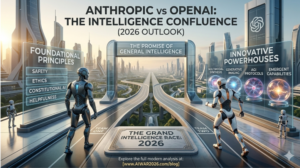
Introduction
2026 is shaping up to be a pivotal year in artificial intelligence (AI), marked by massive infrastructure bets, strategic funding alliances, and shifting ethical debates — all of which have profound implications for businesses and their sales operations.
From tech giants doubling down on AI chip ecosystems to ethical and governance battles over autonomous systems, the AI landscape is evolving fast — and companies that adapt quickly will gain a competitive edge in growth, efficiency, and revenue outcomes.
1️⃣ Big Tech Investments Signal a New Phase of AI Industrialisation
One of the biggest developments in early 2026 is a major strategic funding partnership between Amazon and OpenAI. Amazon announced a $50 billion investment in OpenAI’s infrastructure, including dedicated access to Trainium generational processors, signaling a shift away from reliance on a single AI infrastructure provider and intensifying competition among cloud and chip ecosystems.
This has several business implications:
Lower cost of AI execution — diversified chip access may reduce long-term operational spend.
Faster AI deployment timelines — companies integrating AI into products, services, and workflows can leverage more efficient hardware.
Shifted market dynamics — cloud providers like Amazon and Google will increasingly vie for long-term enterprise AI contracts.
For Indian businesses, this means AI integration — once a competitive differentiator — is becoming a baseline expectation.
2️⃣ Ethical & Regulatory Battles Over the Future of AI
AI’s rapid adoption has triggered high-profile confrontations over how the technology should be governed and used. In early 2026, the Pentagon and AI startup Anthropic entered a dispute over autonomous system usage — with implications for AI limitations, ethical use, and national defense frameworks.
Why it matters:
Governments and enterprises alike are wrestling with how to balance AI power with governance and control.
Ethical decision-making is becoming part of procurement criteria for large organisations.
Companies integrating AI must be prepared for evolving risk, compliance, and accountability demands.
For business leaders, understanding AI beyond utility — including governance, bias, and societal impact — is increasingly part of survival strategy.
3️⃣ AI Infrastructure Innovation Will Fuel Next-Gen Capabilities
2026 also sees hardware evolution that could redefine how businesses use AI.
Nvidia is unveiling a new class of inference-optimized AI processors designed for faster response speeds and energy efficiency, marking a shift from traditional GPU dominance to more specialised AI hardware.
What that means for companies:
Faster real-time analysis and insights — supporting use cases like sales forecasting, intelligent automation, and complex decisioning.
Lower operational costs — efficient inference translates to cheaper AI scaling.
Broader adoption of agentic and workflow AI — systems that can act, not just respond.
This trend accelerates the transition from experimental AI pilots to enterprise-critical AI operations.
4️⃣ Workforce Transformation and AI-Driven Efficiency
AI’s growth isn’t without consequence. Some organisations are restructuring as AI automates routine functions — evidenced by layoffs in firms like BlockXYZ, which announced workforce cuts attributed to expanded AI integration.
This trend is not just about job displacement. It reflects:
AI augmenting productivity — enabling teams to focus on strategic tasks.
Organisational re-skilling imperatives — companies must equip workers with AI literacy.
Shifts in operational structures — AI can redistribute human effort across the value chain.
In the long run, businesses that embrace augmentation — rather than obsolescence — will see stronger future-proof growth.
5️⃣ Putting It All Together — What This Means for Businesses Today
The AI developments of 2026 signal a movement from AI experimentation to AI strategic implementation:
✔ Budget allocations are increasing for AI infrastructure, tools, and talent.
✔ Governance and ethics are part of AI project risk-assessment frameworks.
✔ Competitive landscapes are evolving around specialised AI hardware and software partnerships.
For leaders in sales, marketing, product, and operations — this means:
Systems that just automate tasks won’t be enough; AI must assist decisioning and revenue insight.
Organisations that move AI from isolated pilots to enterprise workflows will unlock disproportionate revenue impact.
Understanding the risks and governance aspects of AI is now critical to sustainable adoption.
Why 2026 Is the Year AI Becomes a Business Differentiator
2026’s AI story isn’t about who built the biggest model — it’s about who operationalises AI in a responsible, scalable, and revenue-focused way.
AI is no longer a buzzword or trend — it’s a strategic lever for competitive advantage.
Companies that invest in infrastructure, governance, integration, and talent now are likely to reap the most long-term reward.
Frequently Asked Questions
What is agentic AI?
Agentic AI refers to AI systems that can initiate actions, make autonomous decisions, and operate independently across workflows — not just respond to prompts.
How will AI governance shape businesses?
Ethical, legal, and compliance frameworks will influence how companies deploy, monitor, and scale AI — especially in regulated industries.
Why does AI hardware matter?
AI performance, energy efficiency, and scalability all hinge on the underlying infrastructure — and emerging chips are reshaping cost and speed dynamics.